
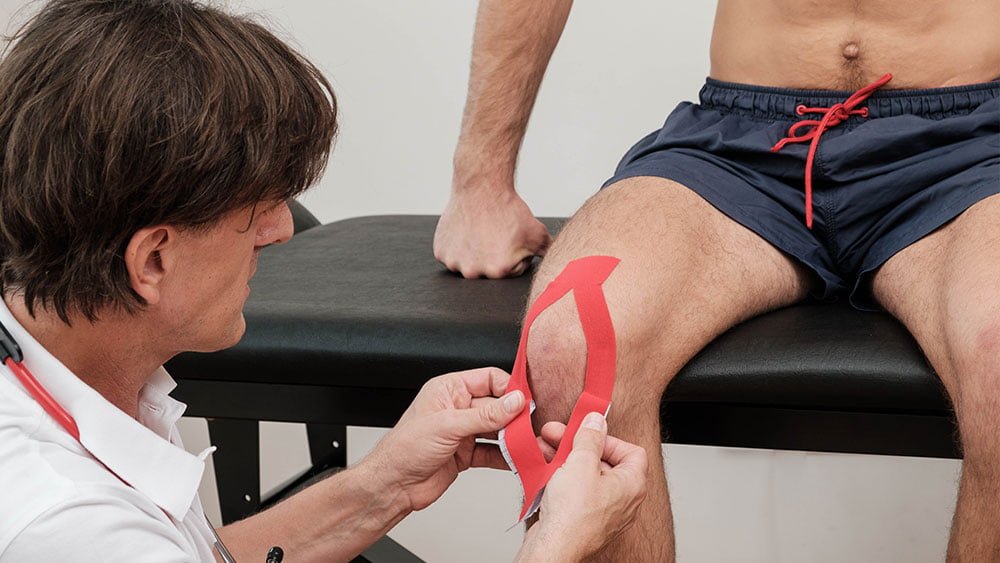
Knee rehabilitation in sport
Because of their exposure and the complexity of their structures, the knee joint and the knee region can suffer serious injuries even from subtle, minor trauma. Osteochondral injuries – that is, combined injuries of bone and cartilage structures – are common because of the particular abundance of cartilage in the knee itself, both on the joint surfaces and inside the joint, where the menisci, crescent-shaped cartilage structures, give the bony joint surfaces additional congruence.
Fractures and dislocations of the kneecap (patella) result from direct trauma; in addition to standard diagnostics, special techniques and views are sometimes needed. Bipartite patella is a developmental anomaly, and it is important not to mistake it for a real fracture. Supracondylar fractures of the femur are also counted among fractures of the knee area because of the close anatomical and functional connection. Likewise, fractures of the upper (proximal) part of the tibia are included in the same group. A fracture, or depression, of the tibial plateau is a very common impression fracture. Injuries in the knee area require prompt rehabilitation. Complications after trauma are common: early complications include impaired blood supply and infection, in open as well as closed injuries. Among the later complications of knee fractures, besides infection, possible failure to heal, non-union and secondary osteoarthritis must be actively looked for. Injuries to bone, cartilage and ligament structures are sometimes so typical that there is a biomechanical pattern.
Meniscal injuries and degeneration present with pain, clicking sounds, instability, or reduced or locked movement. Treatment requires a diagnostic work-up and, based on it, a decision on the type of treatment. Tears can be central or peripheral. Peripheral tears have the potential for partial spontaneous healing. Conservative and surgical treatment are combined to achieve the best possible recovery. Preoperative and postoperative rehabilitation is adapted to the person's clinical status and clinical progress. The anterior and posterior cruciate ligaments and the medial and lateral collateral ligaments further reinforce the joint capsule and contribute to the stability of the knee joint. Injury to them significantly destabilises the knee. Of these injuries, an anterior cruciate ligament injury deserves special mention: combined with an injury to the medial meniscus (usually its posterior horn) and to the medial collateral ligament, it forms what we call a triad. In the literature this triad is also called O'Donoghue's triad or the ‘unhappy triad’, while in Croatia it is known as the skier's triad, although it also occurs in other sports, such as football. Injuries to the quadriceps tendon, the patellar ligament or the iliotibial tract often require surgery in addition to conservative treatment. Remnants of embryonic synovial structures called plicae (folds) can be asymptomatic but also significantly symptomatic. The suprapatellar, mediopatellar and infrapatellar plicae can be affected by chronic inflammation, and some of the symptoms overlap with those of loose bodies in the joint, meniscal injuries, enthesopathies, juvenile osteochondroses, patellar instability and other conditions, which is why examination and appropriate treatment are important.
Disorders of the anterior, medial and lateral segments – or compartments – of the knee present with general and often non-specific symptoms such as pain, swelling and impaired function. The anatomical relationships are evaluated and the physiological and supraphysiological loads assessed so that treatment can be directed at the specific disorder. Anterior knee pain is often the result of chondromalacia patellae, which can be well compensated and controlled with appropriate conservative treatment. Loose bodies in the joint and osteochondritis dissecans are further significant knee disorders that can mask, or be masked by, other conditions in the differential diagnosis. Osteonecrosis is the result of a disturbed blood supply. Arthropathies are joint diseases that can be inflammatory, metabolic or degenerative, and either primary or secondary. Knee tumours are not uncommon. A careful examination, diagnostic work-up and evaluation are needed to rule out this type of disorder. Overuse syndromes of knee structures – such as the iliotibial tract, muscle tears, and enthesitis and enthesopathy at the apex or base of the patella and at the tibial tuberosity – occur in a large number of athletes and recreational sportspeople.


