
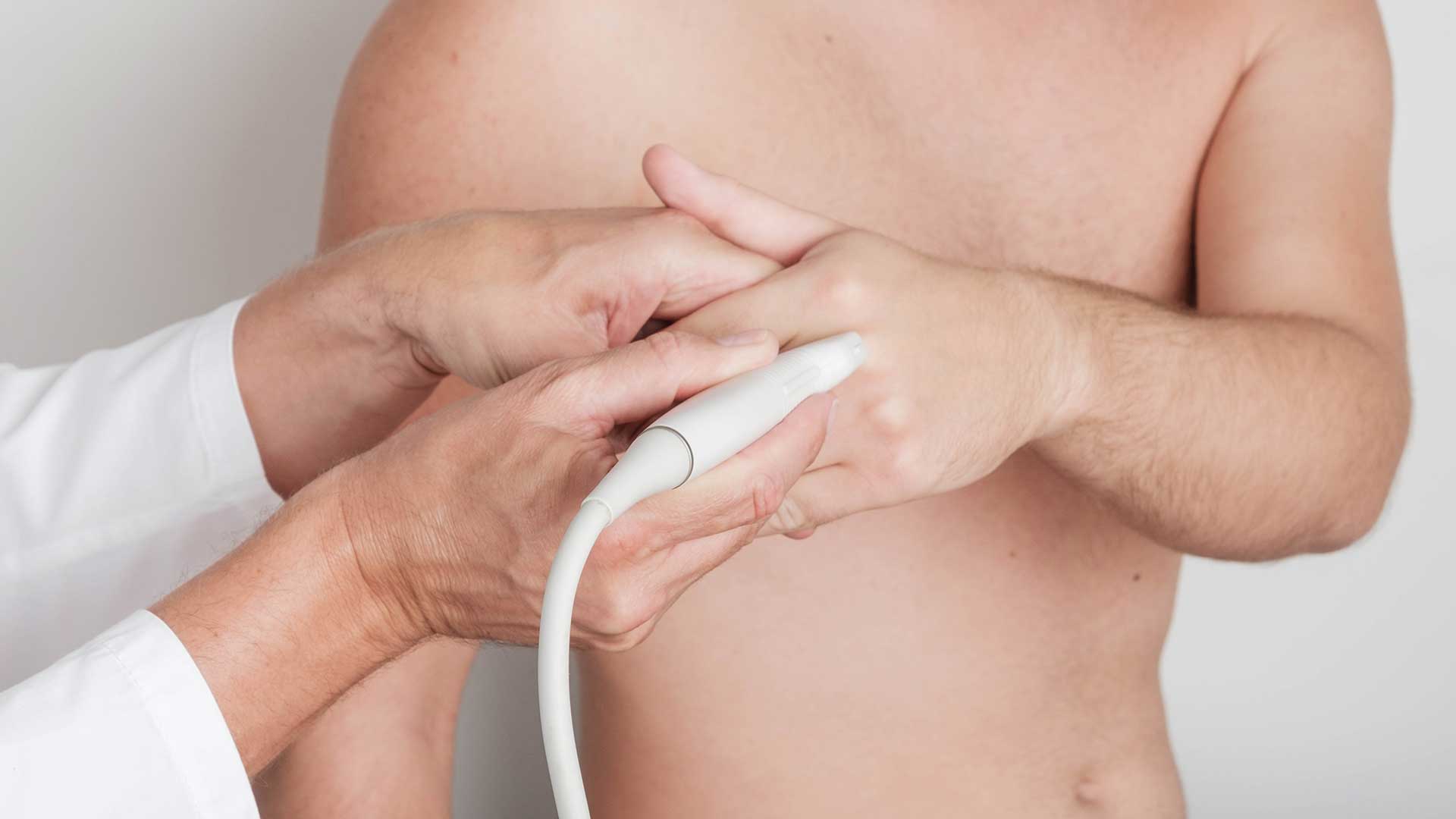
Hand and wrist ultrasound
Diagnostic ultrasound of the hand, wrist and forearm is a diagnostic method that – with the clinical examination as its basis, alongside other imaging tests – differentiates between various pathological conditions. A detailed laboratory analysis is sometimes needed as well. Ultrasound is a good choice when it is put in the context of an examination by a specialist who deals with the musculoskeletal system, such as an orthopaedic surgeon or a physiatrist; other specialists who deal with diseases affecting the hand, wrist and forearm, such as a neurologist or an endocrinologist, can certainly help too.
Ligaments, nerves, tendons, joints and bones are susceptible to many disease processes. Injuries cause partial or complete tears of ligaments and tendons, haematomas and other post-traumatic damage. Overuse syndromes and inflammatory and degenerative diseases cause changes in bony structures, such as osteophytes, while in the nerves they cause median and ulnar neuropathies, with marked tingling, muscle weakness and muscle wasting.
Injuries to the extensor and flexor tendons of the fingers are often neglected by patients and need to be detected as soon as possible. In such cases, diagnostic ultrasound is an excellent method. Cystic swellings in the hand cause pain and also lead to cosmetic problems. By evaluating such swellings we find ganglion cysts, effusions, synovitis and tenosynovitis. In inflammatory rheumatic diseases, we can find inflammatory or metabolic arthritis in the hand, the most common being rheumatoid arthritis, peripheral manifestations of spondyloarthritis and psoriatic arthritis, enthesitis, and also metabolic diseases (gout and pseudogout). The most common changes in the hands are degenerative, such as osteoarthritis, which shows as nodules on the joints of the hand: Bouchard's nodes can form on the proximal interphalangeal joints, while Heberden's nodes grow on the distal interphalangeal joints.
Overuse syndromes lead to carpal tunnel syndrome, and also to tenosynovitis of the thumb abductor and extensor, better known as de Quervain's disease. So-called trigger finger is a thickening of the finger flexor tendon and of the annular pulley, which prevents the tendon from gliding through its canal, so that the tendon catches and limits movement, with pain, weakness and often an audible click. Dupuytren's contracture affects the superficial structure of the palm (its sheath, or fascia), especially the palmar aponeurosis, and presents as a palpable mass, diffuse fibrosis or a nodular change.


