
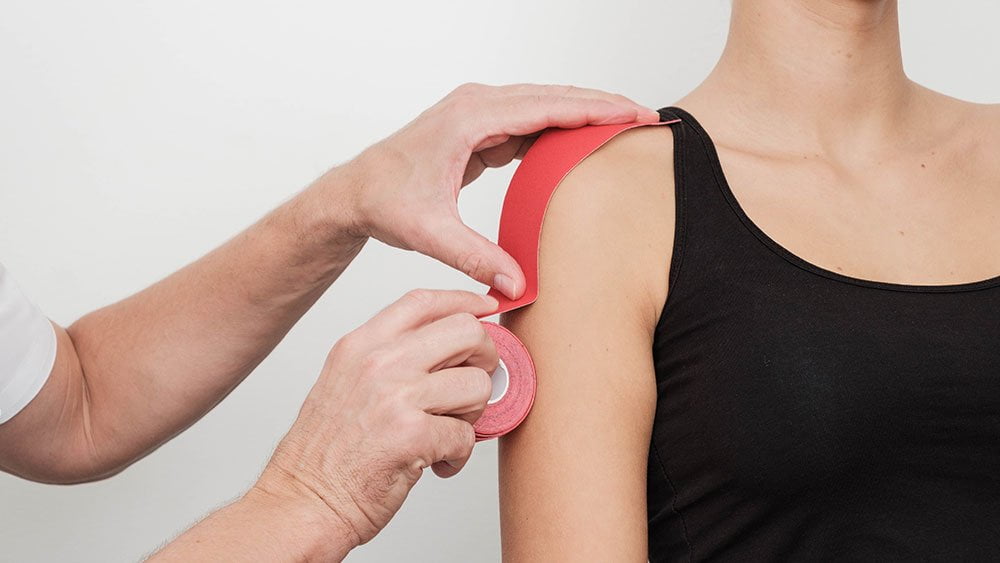
Shoulder rehabilitation
Rehabilitation of the shoulder girdle complex after injuries and degenerative and inflammatory changes is essential to reduce pain and improve function. The shoulder joint is better described as the shoulder girdle, because it consists of several joints, all of which take part in shoulder movement. The shoulder girdle consists of the glenohumeral joint (between the shoulder blade and the upper arm), the acromioclavicular joint (between the acromion of the shoulder blade and the collarbone), the costovertebral joint (between the ribs and the vertebrae), the sternoclavicular joint (between the breastbone and the collarbone), the sternocostal joint (between the ribs and the breastbone) and the scapulocostal joint (between the shoulder blade and the ribs). Shoulder movements also involve all the neighbouring joints and connections.
The complex nerve supply, bursae, tendons and ligaments can all contribute to reduced function and pain in the shoulder. Pain referred from the neck and internal organs must always be ruled out. The rotator cuff consists of four muscles: supraspinatus, infraspinatus, teres minor and subscapularis. Many other muscles also help to stabilise the shoulder: the deltoid, biceps brachii, teres major, rhomboids, serratus anterior, trapezius and levator scapulae. Shoulder rehabilitation is a complex task that requires a specialist medical examination, diagnostics and rehabilitation.


