Physiatry and physiotherapy
Physical medicine is a branch of medicine that brings together a number of medical disciplines and also links medicine with other scientific disciplines. Physical medicine helps people with a wide range of conditions, above all those dominated by pain and impaired function.

It helps above all with conditions dominated by pain and impaired function.
A specialist in physical and rehabilitation medicine leads the examination, diagnostics and treatment.
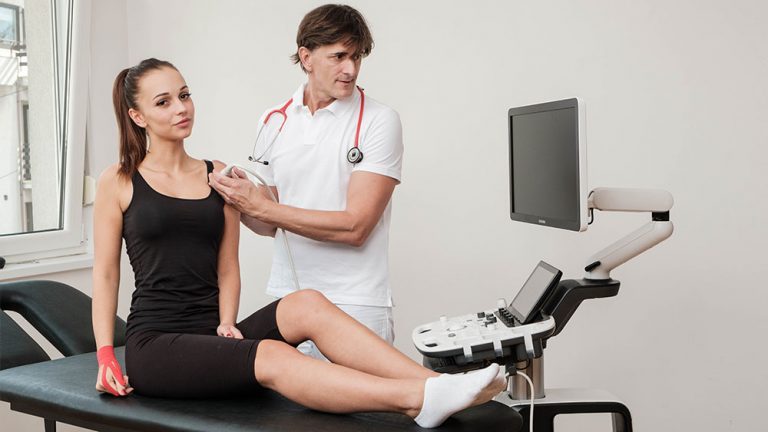
Electrodiagnostics, musculoskeletal and vascular ultrasound, and joint injections.
Therapeutic exercise, physical and chemical modalities, medicines and natural healing factors.
Diseases affecting the muscular and skeletal systems may originate in those systems, or they may result from damage to the nervous, cardiac or pulmonary systems; they can also be a consequence of systemic disorders.
The specialist doctor working in this field is called a physiatrist, or a specialist in physical and rehabilitation medicine. A physiatrist is a medical doctor who knows the universal principles of medicine and has undergone further training in examination, diagnostics and treatment. Physical medicine – that is, the specialist physiatrist – sees the patient as a whole, in all their aspects, both physical and psychological, and in their interaction with their environment.
Physical medicine and rehabilitation is the modern queen of medicine, just as athletics is the queen of sports. Physical medicine carries out diagnostic and therapeutic procedures such as electrodiagnostics, musculoskeletal and vascular ultrasound and joint injections; all other diagnostic procedures are also available, from X-ray, computed tomography (CT), magnetic resonance imaging (MRI) and skeletal scintigraphy to laboratory methods and diagnostics. Physical and rehabilitation medicine is founded on anatomy, kinesiology and biomechanics, so that it can reduce and eliminate pain and dysfunction using therapeutic exercise, physical and chemical modalities, medicines and natural healing factors.
Physiatry, physical medicine, and physical medicine and rehabilitation are terms that are all in use and overlap with one another.

Physiatry, or physical and rehabilitation medicine, is a medical discipline that brings together a number of medical disciplines and links medicine with other scientific disciplines. The specialist doctor working in this field is called a physiatrist, or a specialist in physical and rehabilitation medicine.

Find out more
Physiotherapy uses exercise (that is, movement), therapeutic modalities and natural healing factors to achieve the best effect: therapeutic modalities such as electrotherapy, magnetotherapy, therapeutic ultrasound, laser and shockwave therapy, together with structured, tailored exercises.
Find out more
specialist in physical medicine and rehabilitation, rheumatology subspecialist
Harvard Medical School · Charité Berlin · member of the American College of Rheumatology

specialist in physical medicine and rehabilitation, rheumatology subspecialist
member of the ISPRM (International Society of Physical and Rehabilitation Medicine)

specialty trainee in physical medicine and rehabilitation
Harvard Medical School · Leeds · Milan · Vienna · member of the ISPRM

Mobile: 099 3737 333
Email: info@faktorzdravlje.com
Monday to Friday from 8 am to 8 pm, and on Saturdays from 9 am to 1 pm.