
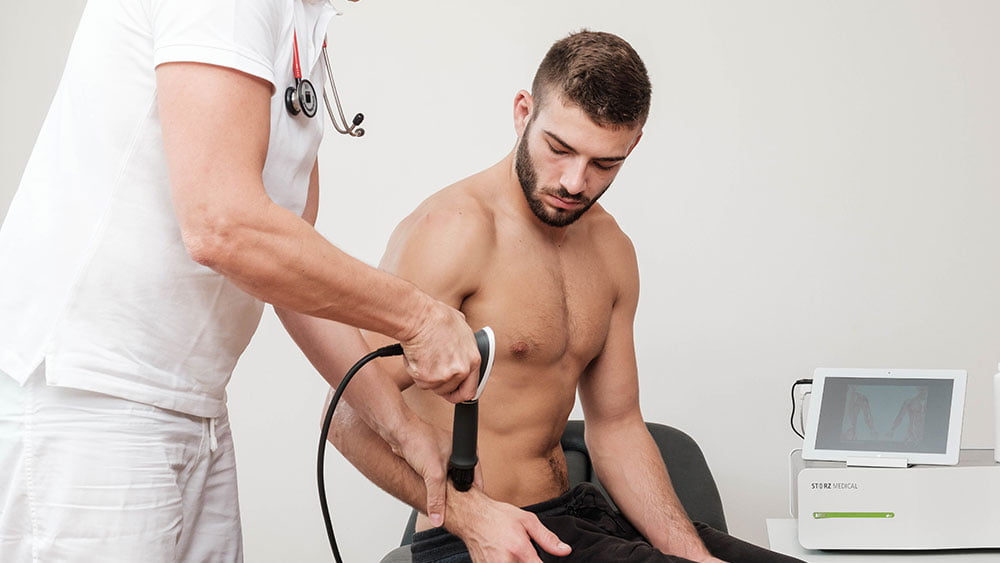
Shockwave therapy
We most often use shockwave therapy for:
– heel spurs/plantar fasciitis/Achilles tendinitis
– patellar tendinitis/enthesitis of the patella and tibia/jumper's knee
– trochanteric enthesitis/iliotibial band tendinitis
– lateral and medial epicondylitis/tennis and golfer's elbow
– shoulder calcifications/frozen shoulder/supraspinatus tendinitis
What is shockwave therapy and how can it help patients?
Shockwave therapy is a physiotherapy method applied directly to the part of the body we want to treat. In physiatry, it is used as one of the methods of treating pain, and ideally you should be examined before treatment by a specialist in physical and rehabilitation medicine, a rheumatologist or an orthopaedic surgeon. In recent years, many scientific papers have shed light on its benefits, as well as on the right indications for shockwave therapy.
How does shockwave therapy work?
Once a specialist physiatrist, rheumatologist or orthopaedic surgeon has established the exact cause of the problem through a detailed clinical examination – which very often also requires imaging (X-ray), musculoskeletal ultrasound and sometimes an MRI – shockwave therapy can begin. Before treatment, we apply gel or a similar medium to the area being treated; this improves contact with the skin and helps the applicator move over the surface, so that the shockwaves pass into the tissue more easily. The applicator contains rapidly moving projectiles controlled by a compressor. These projectiles transfer energy to the applicator, which generates the shockwave. Depending on the applicator, a radial, planar or focused shockwave can be emitted. Frequency and pressure can be adjusted to improve absorption and to gradually decrease or increase the effect on the tissue, according to the indication and the response to treatment.
Scientific studies point to several mechanisms by which shockwave therapy works.
Shockwave therapy reduces pain through the production and modulation of neurotransmitters such as ‘substance P’ and through hyperstimulation of the sensory pathways.
By transmitting force, vibration and pressure, shockwave therapy has several effects:
– it stimulates blood flow and neovascularisation
– it increases growth factor levels in the tissue
– it increases the production of mesenchymal cells
– it stimulates cell metabolism
These effects reduce the formation of calcifications and fibrosis. The idea that the shockwave simply breaks things up mechanically is more a figure of speech than the truth: shockwave therapy acts on cells and cellular processes, so that they change the tissue through rebuilding, remodelling and other effects.
The treatment is relatively short, but the patient feels the effect for longer. Depending on the indication, a treatment lasts from 2 to 10 minutes.
Important: shockwave therapy is only one of the methods we use in physical and rehabilitation medicine. Your doctor will recommend the right one for you.
Shockwave therapy is always used alongside various types of exercise, manual therapy or other physiotherapy techniques and methods, which the patient carries out both at the clinic and at home.
Indications for shockwave therapy.
Successful use of shockwave therapy depends above all on the right indication. No method is good if it is applied uncritically, either when deciding on treatment or during therapy. Evaluation after therapy is essential to achieve the desired effect, as is patience on the part of the patient, the doctor and the physiotherapist. Shockwave therapy is a safe method with very few side effects. Changes in the tissue are gradual rather than sudden. Shockwave therapy stimulates cellular processes to bring about changes in the tissue structure, while its mechanical effect on the tissue is only incidental. Most often, we treat degenerative processes, overuse syndromes and minor local inflammation, which is itself a result of degeneration. Treatment for other indications is less effective.
The structures most often treated are tendons, ligaments, bone segments, muscles, fasciae and other connective tissue structures, as well as neurological disorders. Different structures often overlap, so one indication may include or exclude another.
1. Tendons/ligaments: painful Achilles tendon, patellar ligament, rotator cuff tendons (especially the supraspinatus), lateral/medial epicondylitis
2. Bones: medial tibial stress syndrome, greater trochanteric pain syndrome
3. Neurological problems: a beneficial effect on spasticity shown in controlled studies, both in patients with hemiplegia after a stroke and in children with cerebral palsy; Valleix points; acupuncture points
4. Muscles: increased muscle tone (hypertonia), muscle pain, trigger points, Valleix points
5. Connective tissue and fascial structures (plantar fascia, trigger finger, scar tissue)
There are other indications as well, which you should discuss with your doctor.
Shockwave therapy in everyday practice.
Various types and models of device are used in shockwave therapy. A test application is recommended, because the response to treatment varies from person to person. The number of pulses, their frequency and the pressure applied must be adjusted during the course of therapy. The use of painkillers and other complementary methods is solely a matter for the specialist doctor – physiatrist, rheumatologist, anaesthetist or orthopaedic surgeon. Patients should not take painkillers, non-steroidal anti-inflammatory drugs or anticoagulants on their own initiative, because of the possibility of a haematoma or bleeding at the treatment site. Spontaneous haematomas require blood tests, which will be carried out if the doctor considers them necessary.
Shockwave therapy and its effect on the patient.
Besides medication, injections, acupuncture or surgery, patients with acute or chronic pain syndromes can also be treated with physiotherapy methods, and shockwave therapy is one of them. The right indication is the key to success.
Shockwave therapy is less invasive and less stressful, takes less time and is applied to the affected part of the body. The treatment can sometimes cause minor discomfort and pain, but each patient is treated individually, which means the intensity of therapy is adjusted to their health condition. Shockwave therapy regenerates tissue and improves its blood supply, breaks down calcifications, reduces pain and improves function. It is applied every 5–7 days.
Shockwave therapy is a non-invasive, clinically proven physiotherapy procedure used for acute and chronic musculoskeletal conditions.
Advantages of shockwave therapy:
– a real alternative to surgery
– it treats the cause as well as the symptom
– highly effective when the indication is right
– average duration 2–10 minutes; 4–10 treatments
– limited side effects that pass on their own (slight redness, mild temporary swelling, haematoma)
– a change in sensation, above all in pain
– effectiveness supported by research
We provide shockwave therapy at Faktor Zdravlje Polyclinic in Zagreb. Before therapy, the doctor assesses whether it is suitable for you.
Appointments: 01 3737 333 · info@faktorzdravlje.com · Domobranska 25, Zagreb


