
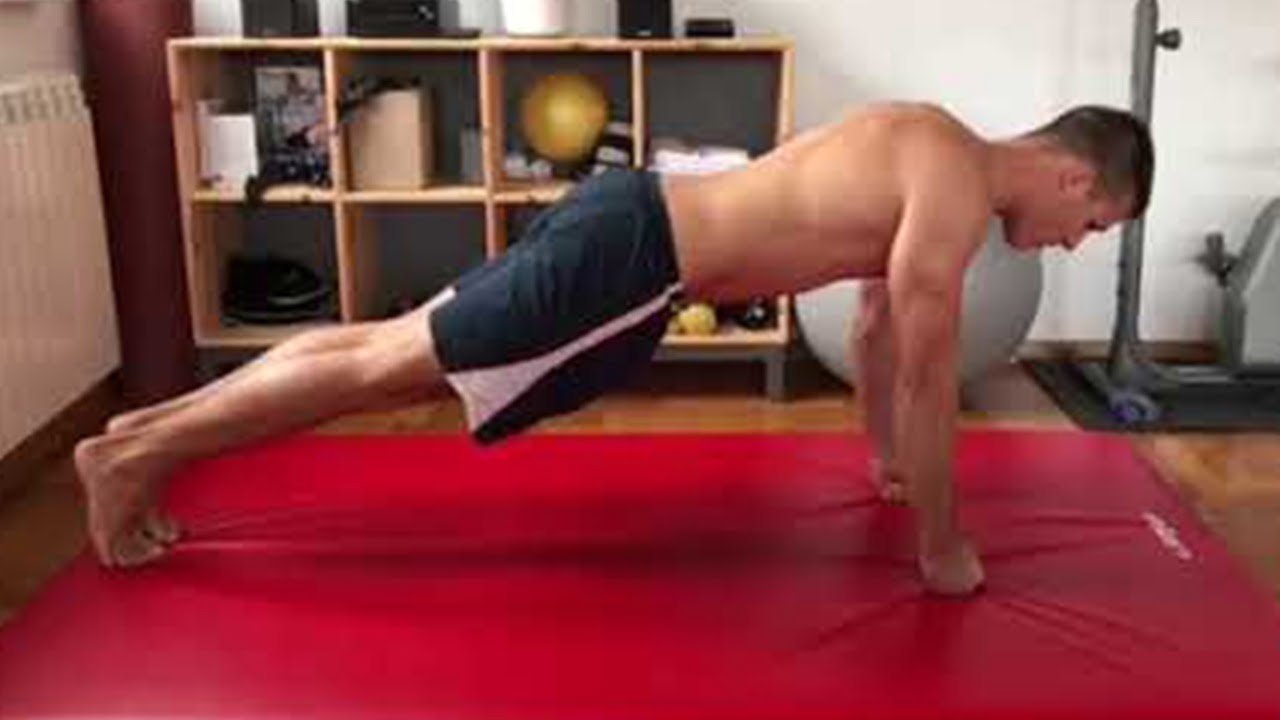
The plank – a static hold – is one of the most effective exercises for the trunk and also for the limbs. It looks harmless and simple, but anyone who has tried it even once knows how beneficial and how demanding it is. Doing the plank melts fat deposits and strengthens the muscles. The plank makes the deep and superficial muscles of the trunk and limbs contract.
How to do it: resting on your forearms and toes and additionally tightening your abdominal and pelvic muscles, stabilise your trunk in the basic position, with your head and legs in line with your trunk. Make sure your pelvis does not sag; it helps to tuck your pelvis under slightly (a posterior pelvic tilt), which has an additional effect on the trunk and pelvic muscles. Your forearms must be directly below your shoulders (not too far forward or back), and your feet no more than 90 degrees to your lower legs (less is fine, more is not)
The exercise is part of training in almost every sport. It is relatively gentle on the spine – in fact, if done correctly, it protects it.
As a specialist physiatrist-rheumatologist working with the musculoskeletal system, I use exercise to achieve an additional effect on other organs as well, such as the heart, lungs and brain. One IMPORTANT note: we must keep breathing while doing the exercise, so do not hold your breath.
The plank can be done in several variations:
1. Straight-arm plank – this activates the triceps and the shoulder blade stabilisers.
2. Reciprocal plank – we alternately lift one arm and one leg, which, along with balancing the body, works the muscles even more and adds dynamism for all those who say the plank is boring. Boredom is an excuse for laziness.
3. Side plank – apart from the name, this exercise is different in many ways and deserves a separate article.
Start the classic plank with 20 seconds and gradually increase to 90 seconds – more advanced exercisers up to 4 minutes – over 4–6 weeks. The plank, held on the elbows, correlates strongly with physical fitness. The exercise is extremely demanding, so to motivate the people who exercise at the Faktor Zdravlje medical centre, I usually use the phrase: ‘Let's have a little rest.’ That puts a smile back on everyone's face.


