
Diagnostic test
Capillaroscopy
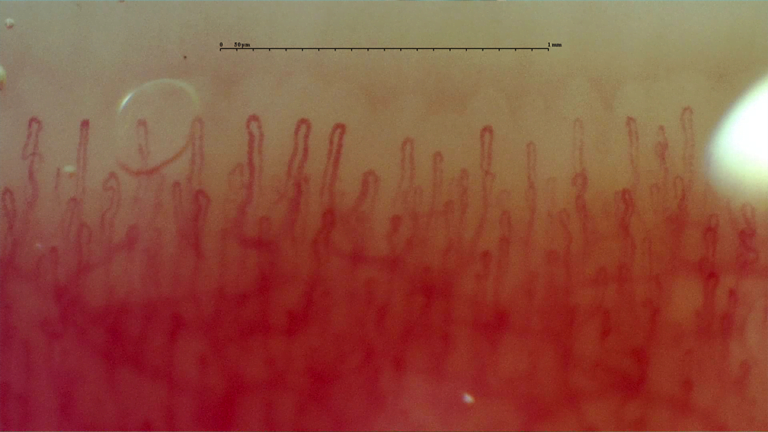
Capillaroscopy is a non-invasive method of examining periungual capillaries (at the base of the nail). It provides insight into the microcirculation and helps detect systemic connective tissue diseases early. Capillaroscopy is a quick, painless and non-invasive diagnostic method with an important role in the early detection of systemic connective tissue diseases.
The examination at a glance
Examination of the nailfold capillaries
A capillaroscope is used to examine the periungual capillaries at the base of the nail.
Non-invasive and painless
The examination is non-invasive and painless.
About 10–15 minutes
The examination takes about 10–15 minutes after a short acclimatisation period.
No referral needed
The polyclinic is private, so no referral is needed.
Which diagnoses is capillaroscopy used for?
It is used for: Raynaud's phenomenon (primary/secondary), systemic sclerosis (SSc), dermatomyositis/polymyositis, mixed connective tissue disease (MCTD), systemic lupus erythematosus (SLE) and, less often, psoriatic arthritis and vasculitis. It also has a role in differential diagnosis and in physiatry (e.g. in atypical pain syndromes).
Capillaroscopy in Raynaud's phenomenon
Raynaud's shows as colour changes in the fingers (white–blue–red) with cold or stress, or for no obvious reason.
Find out moreCapillaroscopy in systemic sclerosis (SSc)
Systemic sclerosis (SSc) is the prototype disease with a pattern recognisable on capillaroscopy.
Find out moreCapillaroscopy in dermatomyositis and polymyositis
Idiopathic inflammatory myopathies often show microvascular changes linked to disease activity.
Find out moreMixed connective tissue disease (MCTD)
Capillaroscopy helps to assess disease activity and can guide treatment decisions.
Find out moreSystemic lupus erythematosus (SLE)
Systemic lupus erythematosus (SLE) shows heterogeneous microvascular changes.
Find out morePsoriasis and psoriatic arthritis
Psoriasis can involve changes in the microcirculation even without classic vasculitis.
Find out moreVasculitis and rheumatoid arthritis (RA)
In vasculitis and rheumatoid arthritis (RA), microvascular changes can be seen, especially in active phases.
Find out morePaediatric capillaroscopy (children and adolescents)
In children with Raynaud's, capillaroscopy helps detect the secondary form early.
Find out moreCapillaroscopy in physiatry and pain syndromes (CRPS – differential diagnosis)
Complex regional pain syndrome (CRPS) shows autonomic and trophic changes; capillaroscopy is not a diagnostic criterion, but it can help with the differential diagnosis.
Find out more
What is seen (findings in brief)
The examination assesses capillary density (usually 7–12/mm), the presence of megacapillaries, microhaemorrhages, avascular areas, neoangiogenesis and tortuosity. A normal finding shows regular U-shaped loops with no haemorrhages and no loss of capillaries.
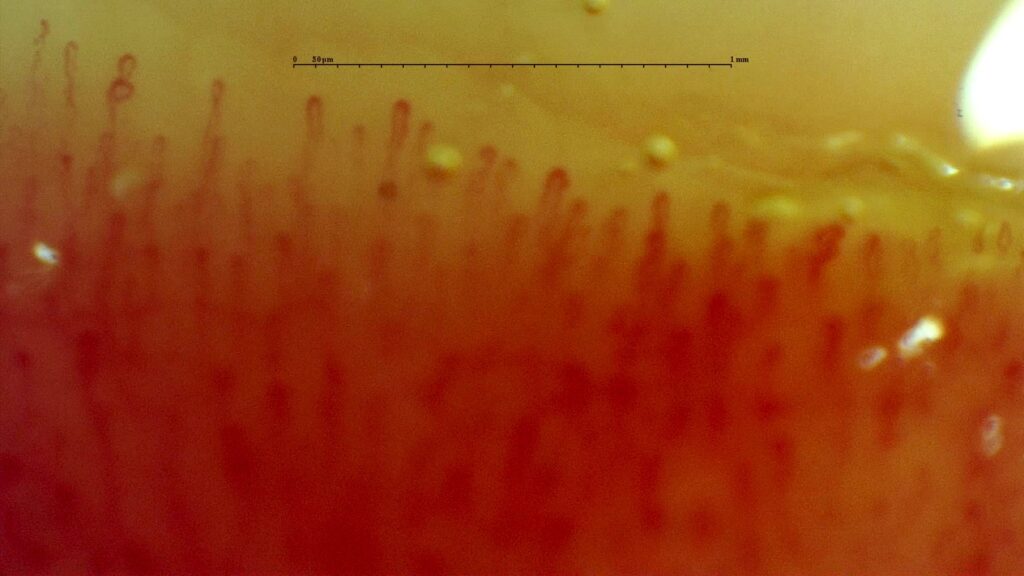
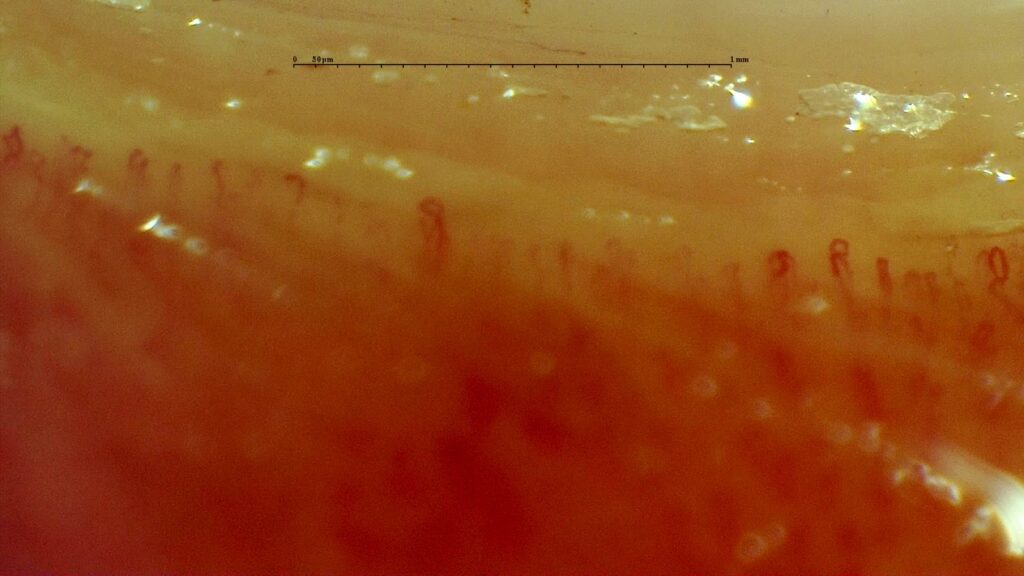
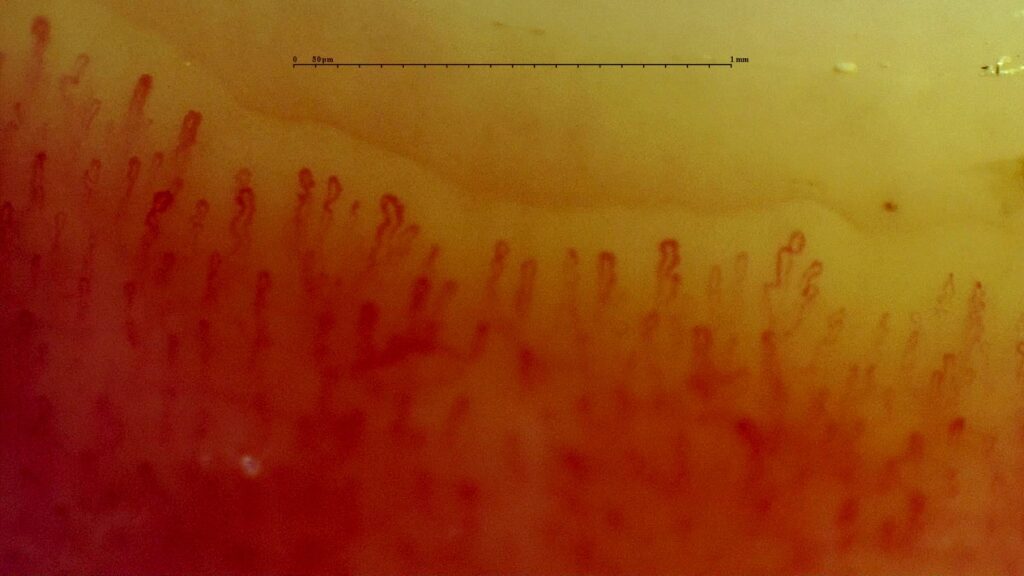
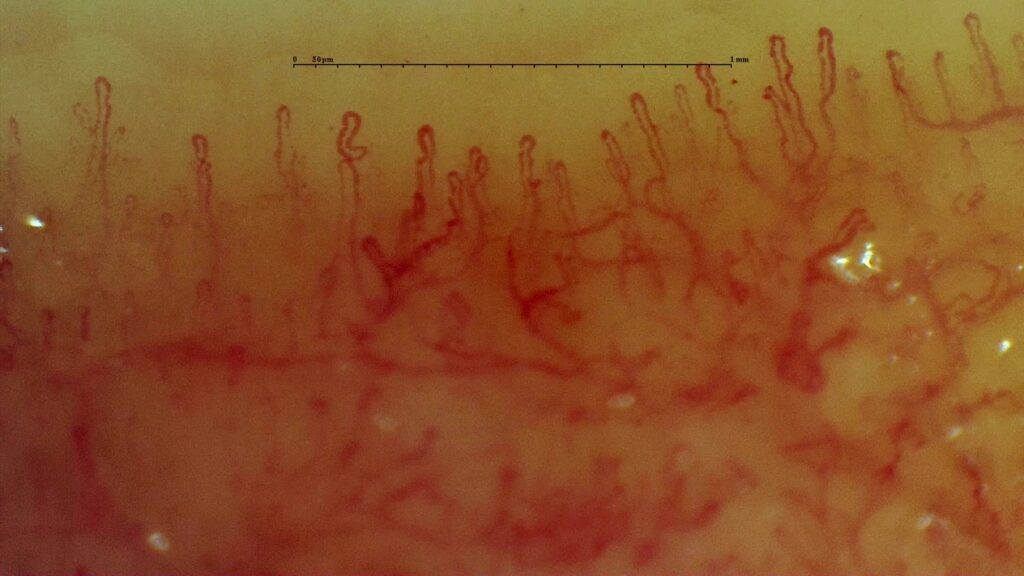
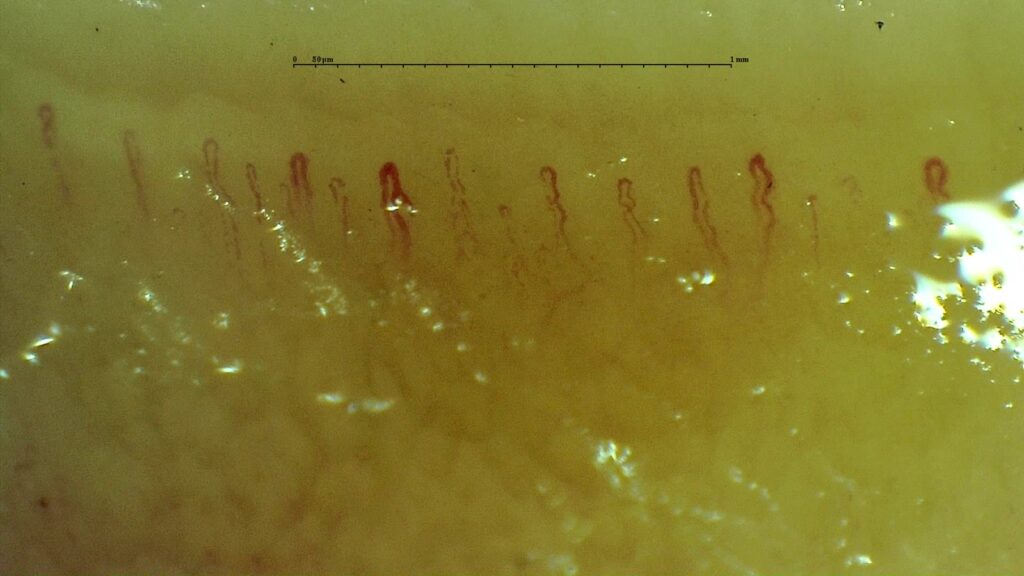
Videocapillaroscopy images: capillaries at the base of the nail under magnification (scale on the image: 1 mm).
Advice for patients before capillaroscopy
Nails
Please come without nail polish, gel or acrylic nails (remove them at least 10 days beforehand); avoid cuticle care and manicures for 7 days beforehand.
On the day of the examination
No cream or oil for 2 hours, no nicotine or caffeine for 2–4 hours.
Cold
Avoid cold and microtrauma around the nails before the examination.
Medicines
Do not stop your medicines on your own; any wash-out of vasoactive medicines is agreed with your doctor (NSAIDs usually do not interfere).
How often should you have a check-up?
Normal findings and primary Raynaud's phenomenon
12–24 months
Abnormal findings / high risk
3–6 months
or more often if clinical indicators show a change
Active systemic sclerosis (SSc) or idiopathic inflammatory myopathy (IIM)
2–3 months
These are the usual intervals between check-ups; your doctor sets them according to your findings.
More about capillaroscopy
Capillaroscopy is a diagnostic test used in rheumatology, dermatology, physiatry, neurology and many other branches of medicine to analyse microcirculation at the capillary level in detail and at high resolution.
A capillaroscope is a device with which we directly visualise the microcirculation. In rheumatology there are a number of diseases that affect the microcirculation (capillaries, arterioles and venules). The capillaroscope makes it possible to visualise the microcirculation safely, painlessly and very precisely, down to the level of individual capillaries, some of the blood cells as they pass through the narrow capillary network, and changes in the capillary walls.
The most common reason for capillaroscopy is a change in the colour of the fingers that occurs spontaneously or is provoked by stress, cold or medicines. This colour change is called Raynaud's phenomenon, and it is characterised by colour changes in the fingers, toes, ears or nipples. In Raynaud's phenomenon the colour changes from blue and white to red. The duration of Raynaud's phenomenon varies; it is often painful, but not every time and not for everyone. There is primary Raynaud's phenomenon, but also a secondary form in inflammatory rheumatic diseases.
Systemic sclerosis is an autoimmune, inflammatory rheumatic disease of unknown origin in which several tissues and organs undergo changes. With capillaroscopy we can see changes typical of systemic sclerosis, whether early and initial, active or late. Other diseases, such as mixed connective tissue disease (MCTD), overlap syndromes of several rheumatic diseases, collagenoses and psoriatic arthritis, can also show changes in the microcirculation.
We describe the changes we see using various categories, most often as early fibrotic reactions, capillary collapse, dilatation, extravasation of red blood cells, microvascular haemorrhages, arborisation of capillaries, changes in permeability, angiogenesis, necrosis and diffuse changes. Besides the skin, systemic sclerosis affects many other organs, such as the kidneys, lungs, gastrointestinal system and others.
It is important to monitor people with microcirculatory changes over the long term, regularly, systematically and consistently. Capillaroscopy is a safe, non-invasive and painless method that can detect changes in the microcirculation at the base of the nail early. Together with the clinical picture and laboratory results, this makes it possible to establish the correct diagnosis, start treatment as early as possible and avoid local and systemic damage.
Doctors who perform capillaroscopy
Capillaroscopy is performed by Dr Mijić and Dr Novak, both of whom have many years of experience.

Dr Šime Mijić
specialist in physical medicine and rehabilitation, rheumatology subspecialist
Further training in capillaroscopy in Genoa, Vienna and the USA · author of a scientific article on capillaroscopy
Dr Ivan Novak
specialty trainee in physical medicine and rehabilitation
Further training in capillaroscopy in Vienna


Appointments and contact
Where to find us
Domobranska 25, 10000 Zagreb
Monday to Friday from 8 am to 8 pm, and on Saturdays from 9 am to 1 pm.


