
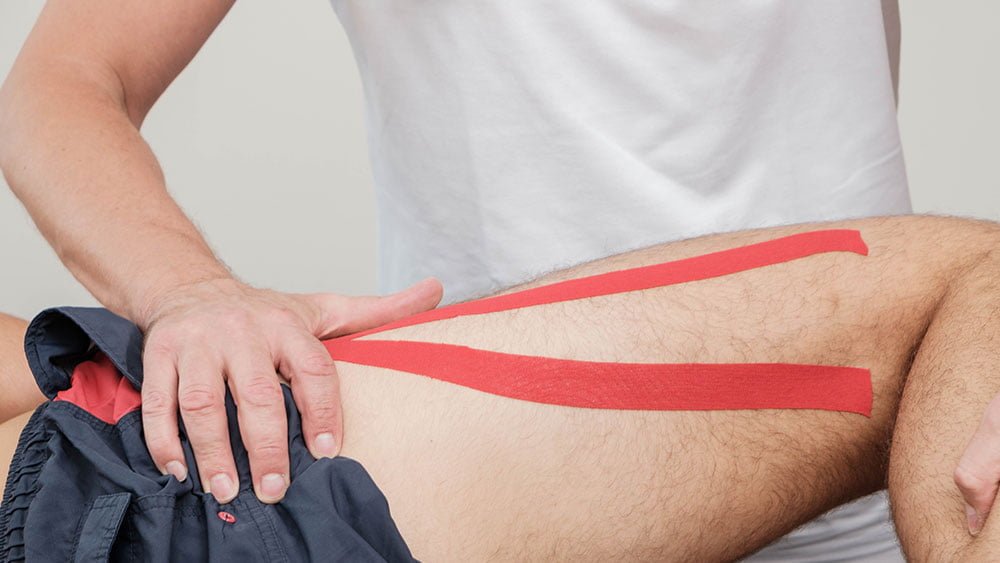
Hip rehabilitation in sport
The pelvis, hip and thigh form a functional and anatomical unit. Injuries and overuse syndromes are common, especially in contact sports. Injuries to soft tissues such as muscles, tendons and fasciae are common with moderate trauma, while major trauma results in bone fractures. A medical examination is essential to determine exactly which structures have been injured, especially because some structures in the pelvis and hip lie very deep and cannot be reached by the usual examination methods. The mechanism of injury is very important, and witnesses or the injured person themselves provide information for the medical history that helps to reconstruct how the injury may have happened.
Besides clinical diagnosis, soft-tissue injuries of muscles and tendons are diagnosed with ultrasound, magnetic resonance imaging, computed tomography, bone scintigraphy and other methods. Once a suspicion has been raised from the clinical examination and medical history, injuries to nerve structures are diagnosed with magnetic resonance imaging, as are injuries to the acetabular labrum, while bursitis is well visualised with diagnostic ultrasound. We must emphasise that diagnostic tests complement one another and that clinical and radiological correlation is always needed. Snapping hip (coxa saltans) – the sensation, and sometimes the audible sound, of tendons snapping over the hip – is a common reason for seeing a doctor; it can be a sign of a serious disorder or a benign sign that needs no treatment. Avulsion injuries of the ilium (iliac bone) occur at the attachments of muscles and tendons, or from a direct injury to the structure itself. Complex injuries occur with greater forces in contact sports, motor sport, cycling and other activities. Because the pelvic area also contains nerve, vascular and urogenital structures as well as gastrointestinal ones, there is a risk of significant complications, from infections and bleeding to paralysis.
The deeper structures of the locomotor system include the acetabulum and the structures belonging to it that make up the hip joint in the narrower sense. Sometimes only the marginal structures, such as the acetabular labrum, are injured, and because they are difficult to diagnose they cause long-lasting problems, with significant limitation of function and difficulties during work and sports activities. Femoroacetabular impingement (FAI) is a distinct clinical syndrome. Dislocation of the hip, in the form of subluxation or luxation, together with injuries to the joint capsule and ligaments and the frequent resulting osteonecrosis, can lead to serious complications. Fractures of the femoral neck usually result from a fall onto the hip. Complications after such injuries are extremely common and mortality is high: in the older population it is almost 30%. Whenever possible, surgery is essential. Trochanteric fractures, such as avulsion, subtrochanteric and pertrochanteric fractures, also carry significant complications and mortality. Insufficiency fractures – in osteoporotic bone, in bone that is somewhat weaker because of certain medicines, or with inadequate nutrition and inadequate levels of activity – usually affect the sacrum, the pubic rami, the supra-acetabular area and the femoral neck, while atypical fractures occur in the shaft of the femur. Bone oedema, or bone marrow oedema, is often visible after trauma; alongside appropriate treatment and monitoring, causes other than trauma also need to be ruled out, such as a tumour, infection, transient osteoporosis and others. In female athletes, poor nutrition and loss of the menstrual cycle, as well as pregnancy, the period after childbirth and breastfeeding, are common conditions that lead to osteoporosis, osteopenia and transient osteoporosis. In younger people, with appropriate rehabilitation, nutrition and the passage of time, such conditions can improve significantly, sometimes to the point of complete resolution.
Tumours are a separate topic. Children and adults, athletes and non-athletes alike can develop malignant diseases. The tendency of lay people to attribute everything to trauma leads to delayed work-up and diagnosis, and every doctor following good clinical practice must bear this in mind, especially if the medical history, clinical examination and diagnostic tests give no clear explanation for the symptoms or for a structure seen on clinical examination and imaging. Malignant tumours include Ewing's sarcoma, chondrosarcoma, fibrosarcoma, myeloma, osteosarcoma and lymphoma, while benign tumours include osteoid osteoma, chondroblastoma, giant cell tumour, osteochondroma, chondroma and others. Soft-tissue tumours include liposarcoma, alveolar soft part sarcoma, synovial sarcoma, epithelioid sarcoma, malignant fibrous histiocytoma and fibrosarcoma, while benign ones include lipomas, myxomas, haemangiomas, benign nerve sheath tumours and desmoid tumours. Arthropathies, or arthritis, resulting from injury, inflammation and overuse syndromes can occur in athletes as well as in the general population. Affected joints produce marked symptoms, especially if the sacroiliac joint or the hip joint is involved. Developmental disorders of the hip in children, young people and athletes can also be a reason for seeing a doctor: Legg–Calvé–Perthes disease, an ischaemic disease of the femoral head, is common in children aged 3 to 12. Involvement of both hips is not rare either. Hip dysplasia is common after breech birth; it is recognised very early, is more common in girls and is bilateral in more than a third of cases. Slipped capital femoral epiphysis usually occurs in adolescence and is more common in boys, typically between the ages of 10 and 17, most often at 13 or 14; bilateral involvement is almost the rule, in the sense that the doctor actively looks for changes in the other hip too. Congenital and developmental disorders are actively looked for at the earliest stages of development, practically in the maternity ward. Faktor Zdravlje Polyclinic offers specialist medical examination, diagnostics and treatment, and with the help of our experienced experts in rehabilitation medicine we will provide a safe recovery and the highest level of functional movement.
At our polyclinic, sports rehabilitation of the hip is led by a physiatrist and a kinesiologist.
Appointments: 01 3737 333 · info@faktorzdravlje.com · Domobranska 25, Zagreb


