
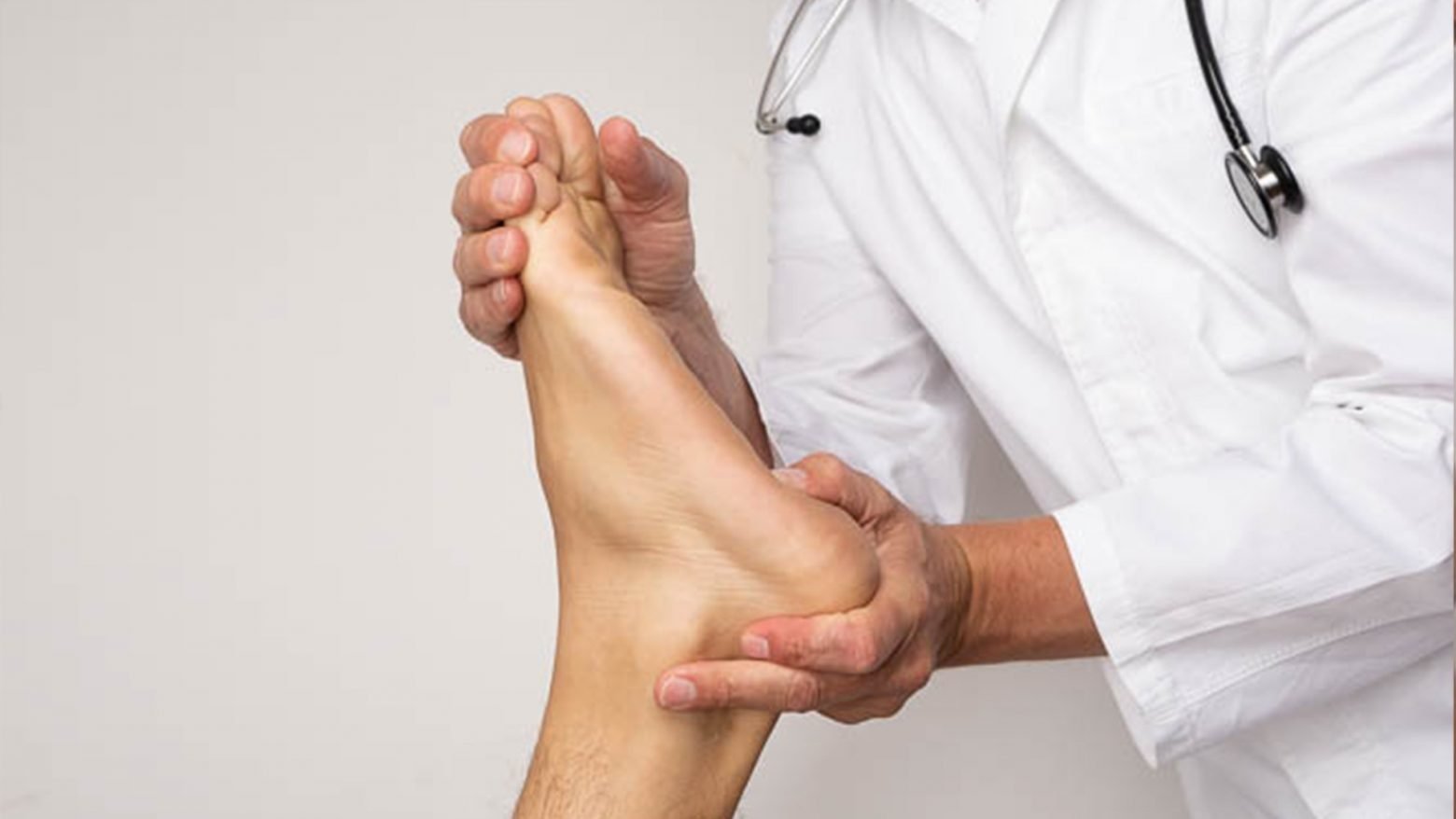
Ankle and foot
The lower limbs consist of the thigh, lower leg and foot, and the hip, knee and ankle joints. Functional and clinical anatomy are always linked, with particular emphasis on the ankle and foot, which we look at together. The ankle joint consists of the shin bone and the calf bone (tibia and fibula), which articulate with the tarsal bones – the calcaneus and talus – and a number of small bones of the foot. Developmental and acquired ankle and foot disorders are very common, especially flat feet, which in a biomechanical sense affect the whole body. Disorders such as pes equinovarus (clubfoot) can develop even in the womb, and this is treated immediately after birth.
A flat foot is a complex problem because, besides changes in the longitudinal and transverse arches of the foot, there are also disorders of the foot bones, particularly the heel (calcaneus), which changes its angle in relation to the lower leg – either valgus or varus (an angle open outwards or inwards in relation to the line of the body). Functionally and clinically, the ankle itself consists of two joints: the upper one, formed by the lower leg bones and the talus, and the lower one, which connects the talus and the calcaneus.
Young people have problems with the growth centres of the heel, known as Sever's disease. In middle age, foot pain is usually the result of overuse syndromes, sprains and/or fractures. There is hardly an athlete who has never sprained an ankle, and a sprain needs good rehabilitation, because the full function and stability of a number of small structures around the ankle must be restored to avoid recurrent sprains. Ankle and foot fractures can be simple or complex, and on the inner or the outer side. Rehabilitation requires the prevention of deep vein thrombosis, along with immobilisation as soon as possible and offloading with crutches.
With minor injuries this can be achieved with orthoses, while larger and more serious injuries require surgery with external or internal fixation. Metabolic diseases such as the build-up of urate crystals (gout) are so characteristic of the feet that gout there even has its own name – podagra. Autoimmune diseases of the feet such as rheumatoid arthritis and spondyloarthritis affect the lower limbs, sometimes symmetrically and sometimes asymmetrically. The lower limbs are more often affected asymmetrically in spondyloarthritis, while reactive, psoriatic and enteropathic arthritis are associated with the MHC antigens HLA-B27 and B35. They are called seronegative because rheumatoid factor is negative, but they can also be associated with various infections, both of the digestive system (Helicobacter pylori) and of the genitourinary system (chlamydia, mycoplasma, ureaplasma). The appearance of the ankle and foot should not be overlooked either – in some Far Eastern civilisations it has come at the expense of function. Caring for your feet is a lifelong task.


